
Have you noticed a rounded bump forming at the base of your neck? You are not alone. Millions of people are searching for how to get rid of neck hump every single day. The good news is that you can often improve this condition. In some cases, it can even be reversed with the right approach.
In this guide, you’ll discover what causes a neck hump. You’ll learn how to check if you have one. Plus, find exercises and lifestyle changes to fix it for good.
What Is a Neck Hump?
A neck hump is a rounded, protruding bump at the base of the neck and the top of the upper back. It develops when the upper spine curves too far forward, pushing soft tissue outward.
You may have heard it called by several names:
- Dowager’s hump — related to poor posture or bone loss
- Buffalo hump — caused by fat deposits behind the neck
- Text neck or tech neck — a modern term for posture damage from screen use
- Kyphosis — the medical term for abnormal forward spinal curvature
These are not all the same condition. Dowager’s hump is a spinal issue. Buffalo hump is mostly a soft tissue problem. Understanding which type you have helps you choose the right fix.
What Causes a Neck Hump? (And Why It’s Getting More Common)

1. Forward Head Posture
This is the number one cause. For every inch your head shifts forward from its natural position, it puts about 10 extra pounds of pressure on your neck. Over months and years, this pressure reshapes the spine.
2. Tech Neck and Screen Use
Bending your neck forward while looking at your phone or computer can cause strain. At a 45-degree angle, your neck carries the equivalent of 50–60 pounds of force. This is why neck humps are increasingly common even in young adults and teenagers.
3. Weak Upper Back and Neck Muscles
When the muscles around the thoracic spine weaken, other muscle groups overcompensate. This leads to chronic strain, poor alignment, and eventually a visible hump.
4. Osteoporosis and Bone Loss
Weakened bones can lead to small compression fractures in the vertebrae. These fractures cause the spine to curve more forward. This is a common reason older adults develop a noticeable hump.
5. Excess Weight and Fat Deposits
Obesity and conditions like Cushing’s syndrome can lead to fat buildup at the back of the neck. This creates a “buffalo hump.”
6. Other Causes
- Genetics and family history of spine conditions
- Age-related disc degeneration
- Scheuermann’s disease (affects spine development in teens)
- Long-term use of corticosteroid medications
How to Know If You Have a Neck Hump (Simple Self-Test)
You do not need a doctor’s visit to spot the early signs. Here is a quick at-home check:
The Wall Test:
- Stand with your back flat against a wall
- Your heels, buttocks, upper back, and head should all touch the wall
- If your head cannot touch the wall comfortably, your posture is already shifting
Visual Signs to Watch For:
- Rounded shoulders that curl inward
- Head that sits in front of your shoulders (not directly above them)
- Stiffness or soreness in the upper neck and shoulders
- Frequent headaches at the base of the skull
- A visible bump or ridge at the lower back of the neck
When to See a Doctor:If the hump appears suddenly, grows fast, causes numbness or tingling in your arms, or is painful, then see a healthcare professional. These could signal a more serious underlying condition.
How to Get Rid of Neck Hump: Step-by-Step Fixes
This is the core of the guide. Here are the best ways to get rid of a neck hump. We’ll cover simple daily habits and some targeted exercises.
Fix #1: Correct Your Daily Posture
Posture correction is the foundation of every other fix. Without it, even the best exercises will only do so much.
At your desk:
- Keep your screen at eye level so your head does not tilt down
- Sit with your back supported and both feet flat on the floor
- Keep your ears aligned directly above your shoulders
On your phone:
- Hold your phone at eye level instead of looking down
- Take a break every 20–30 minutes to roll your shoulders back
- Avoid using your phone while lying down
While sleeping:
- Use a cervical (contoured) pillow that supports the natural curve of your neck
- Sleep on your back when possible — it keeps the spine in a neutral position
- Avoid sleeping on your stomach, which twists and strains the neck
Fix #2: Stretching Exercises for Neck Hump
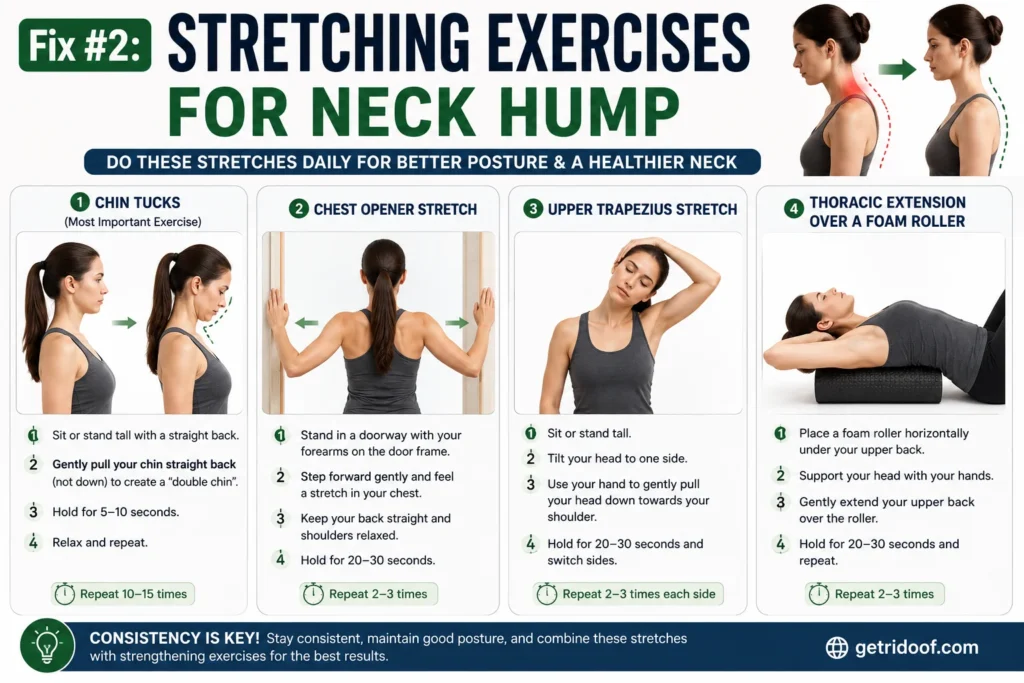
These stretches reduce tightness and begin to reverse forward head posture.
Chin Tucks (Most Important Exercise)
This is the top exercise recommended by physiotherapists to fix a neck hump.
- Sit or stand tall with your spine straight
- Gently pull your chin straight backward — as if making a “double chin”
- Hold for 5 seconds, then release
- Do 3 sets of 10 reps daily
This exercise directly counters forward head posture and strengthens the deep neck flexors.
Chest Opener Stretch
Tight chest muscles pull the shoulders forward, worsening kyphosis. This stretch opens them up.
- Stand in a doorway with your arms raised like a goalpost
- Place your palms on the door frame
- Step one foot forward and lean gently until you feel a stretch across your chest
- Hold for 20–30 seconds, repeat 2–3 times daily
Upper Trapezius Stretch
- Sit upright and drop your right ear toward your right shoulder
- Place your right hand gently on top of your head for a light added stretch
- Hold for 20 seconds each side
- Repeat 3 times per side daily
Thoracic Extension Over a Foam Roller
This move boosts mobility in the upper spine. It targets the kyphosis that leads to a neck hump.
- Place a foam roller horizontally on the floor
- Sit in front of it and gently lean back so the roller sits at your mid-upper back
- Let your head drop back and your arms fall to the sides
- Hold for 10–15 seconds, then shift the roller slightly up or down and repeat
Fix #3: Strengthening Exercises to Correct the Hump
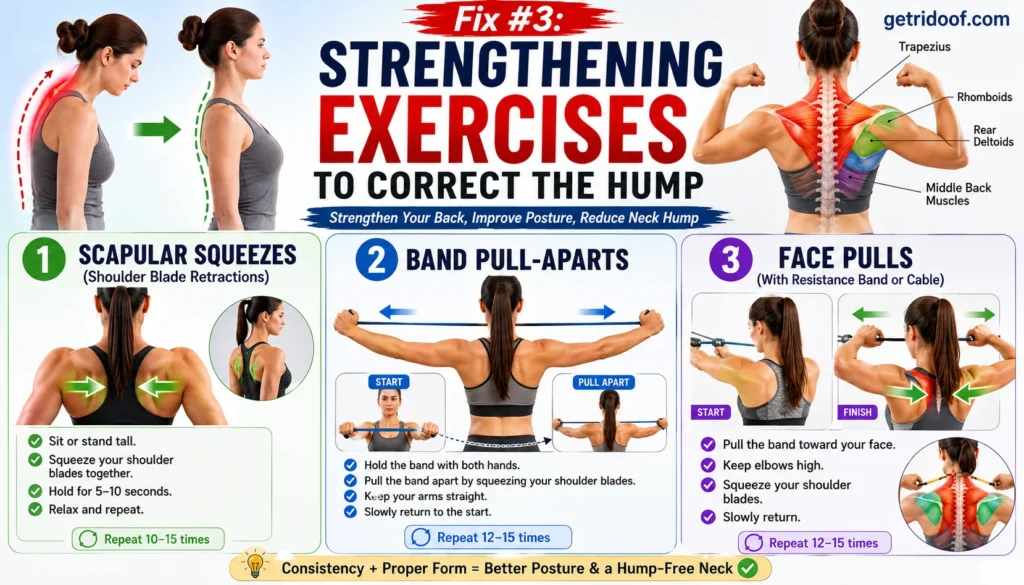
Stretching alone is not enough. You also need to strengthen the muscles that hold your spine in proper alignment.
Wall Angels
- Stand flat against a wall with your arms raised to shoulder height, elbows bent at 90 degrees
- Slowly raise your arms above your head, keeping contact with the wall throughout
- Bring them back down to the starting position
- Do 3 sets of 10 daily
This move trains the upper back muscles to pull the head and shoulders back into alignment.
Scapular Squeezes (Shoulder Blade Retractions)
- Sit or stand upright
- Squeeze your shoulder blades together as if you are trying to hold a pencil between them
- Hold for 5 seconds, then release
- Do 3 sets of 10–15 daily
This builds the muscles that keep your shoulders back and your upper spine straight.
Band Pull-Aparts
You will need a resistance band for this one.
- Hold the band in front of you at shoulder height with both hands, arms straight
- Pull the band apart by moving both arms out to the sides
- Squeeze the shoulder blades together at the end of the movement
- Return slowly and repeat for 3 sets of 12–15 reps
Face Pulls (With Resistance Band or Cable)
Face pulls work the rear deltoids and upper back. These muscles are often weak in people with forward head posture.
- Anchor a resistance band at face height
- Hold both ends and pull the band toward your face, flaring your elbows out
- Squeeze the upper back at the end of the movement
- Do 3 sets of 15 reps daily
Fix #4: Lifestyle Changes That Speed Up Results
Exercise matters, but your daily habits outside of workouts matter just as much.
Move more throughout the day. Sitting for long hours is one of the biggest drivers of poor posture. Set a timer every 30–45 minutes to stand, stretch, and reset your posture.
Maintain a healthy weight. Excess weight — especially around the neck and upper back — increases spinal load. Even modest weight loss can visibly reduce a buffalo hump caused by fat deposits.
Eat for bone and joint health. A diet rich in calcium, vitamin D, magnesium, and anti-inflammatory foods supports spine health. It also lowers the risk of bone loss that can cause kyphosis.
Consider yoga or Pilates. Both practices build the core and postural muscles that support a straight spine. Many people notice better posture after just a few weeks of regular practice.
You Can Also Read
- How to Get Rid of Double Chin
- How to Get Rid of FUPA
- How to Get Rid of Back Acne
- How to Get Rid of Double Chin Faster
How Long Does It Take to Get Rid of Neck Hump?
This is one of the most common questions — and the honest answer depends on the cause and consistency.
| Type of Neck Hump | Expected Timeline |
| Postural (mild to moderate) | 4–12 weeks of consistent effort |
| Postural (severe, long-standing) | 3–6 months or more |
| Fat-related (buffalo hump) | Improves with weight loss over months |
| Bone-related (osteoporosis) | Slower; requires medical support |
The key rule: consistency beats intensity. Doing 10 minutes of the right exercises every day will outperform a one-hour session once a week.
Many people notice better posture in just 4 to 6 weeks of daily chin tucks and scapular exercises. The hump itself may take longer, but you will feel the difference much sooner.
When to See a Doctor About Your Neck Hump
Most neck humps are postural and respond well to the self-care methods above. However, you should consult a healthcare professional if:
- The hump developed quickly without an obvious cause
- You experience pain, numbness, or tingling in your arms or hands
- You have a history of osteoporosis or spinal conditions
- The hump does not improve after 8–12 weeks of consistent effort
- You suspect a hormonal issue (such as Cushing’s syndrome)
Treatment options a specialist may recommend:
- Physiotherapy — personalized exercise programs and manual therapy
- Chiropractic care — spinal adjustments to improve alignment
- Bracing — in some structural cases, a posture brace may help
- Medication — for underlying conditions like osteoporosis
- Surgery — only in rare, severe structural cases
How to Prevent Neck Hump From Coming Back
Once you start seeing improvement, keeping it up is the most important step. Here is a simple daily routine to protect your progress:
- ✅ Do chin tucks and scapular squeezes every morning (5–10 minutes)
- ✅ Check your posture every time you sit down
- ✅ Keep screens at eye level — phone, computer, and TV
- ✅ Sleep on your back with a cervical support pillow
- ✅ Take movement breaks every 30–45 minutes during desk work
- ✅ Stay consistent with upper back strengthening exercises 3–4 times per week
Prevention is far easier than correction. A few minutes of daily awareness can stop the hump from ever returning.
Frequently Asked Questions
Can a neck hump go away completely?
Yes — especially if it is postural in nature and caught early. Many people can fully reverse their neck hump in a few months. Regular stretching, strengthening, and correcting posture help achieve this.
Does a neck hump cause pain?
It can. As the hump gets worse, it often leads to neck and shoulder pain. You might also have chronic headaches. In severe cases, it can make swallowing or breathing hard.
Is a neck hump dangerous?
A mild postural hump is more of a cosmetic and comfort concern. If left untreated for years, it can cause spinal degeneration, less mobility, and serious nerve compression.
Can a pillow help fix a neck hump?
A good cervical pillow supports your neck’s natural curve during sleep. It can also help reduce strain. It is a helpful tool, but it works best alongside exercises and posture correction.
Can teenagers get a neck hump?
Yes. Smartphones and screens are making more young people develop forward head posture and early neck humps. Early intervention makes recovery much faster.
Conclusion
A neck hump does not form overnight — and it will not disappear overnight either. But the path to getting rid of neck hump is clear: correct your posture, stretch what is tight, strengthen what is weak, and be consistent.
Start with just two exercises today — chin tucks and scapular squeezes. Do them every morning for two weeks. You might be surprised at how fast your neck, shoulders, and upper back start to feel better.
If the hump is severe or you feel pain, don’t wait. Talk to a physiotherapist or doctor for a personalized plan.
The sooner you start, the sooner you see results. Your posture — and your confidence — are worth the effort.
Disclaimer: This article is for learning only and is not medical advice. Please consult a qualified healthcare professional before beginning any new exercise program.
About the Author