
If you’ve heard scratching in your walls at night or seen small droppings by your kitchen, you know the panic it causes. How to get rid of mice is one of the most searched pest control questions — and for good reason. Mice are not just a nuisance. They gnaw on wires, taint food, and spread harmful diseases like hantavirus and salmonella.
The good news? You don’t always need to call a professional. With the right strategy, you can get rid of mice fast and keep them from coming back for good.
Why You Should Act Fast When You Spot a Mouse
Mice reproduce incredibly fast. A single breeding pair can produce 60 or more offspring per year. What starts as one or two mice can turn into a full-blown infestation within weeks.
Beyond the numbers, mice cause serious damage. Rodents chew on electrical wires. The National Fire Protection Association estimates that they cause 20–25% of all house fires that are unknown. They harm insulation, contaminate food, and spread bacteria through their droppings and urine.
The sooner you act, the easier and cheaper the problem is to fix.
How to Tell If You Have a Mouse Problem
Before you start treatment, you need to confirm what you’re dealing with. Here are the most common signs of a mouse infestation:
- Droppings
- Look for small, dark, pellet-shaped droppings (3–8 mm) near food sources.
- You might also find them under sinks or along baseboards.
- Gnaw marks — Chewed food packaging, furniture edges, or electrical wiring
- Greasy rub marks — Dark smudges along walls and baseboards from their oily fur
- Nesting materials — Shredded paper, fabric, or insulation in hidden corners
- Scratching sounds — Faint scurrying or squeaking inside walls, especially at night
- Musky odor — A distinctive smell caused by mouse urine
Fresh droppings are dark and moist. Older ones turn dry and lighter in color. If you see fresh droppings, mice are still active in your home.
Why Mice Enter Your Home in the First Place
Understanding why mice come in helps you stop them permanently. Mice are looking for three things: food, warmth, and shelter.
They become most aggressive about entering homes in October and November. This is when it gets cooler. A mouse can squeeze through a gap as small as a dime — so even tiny cracks are enough.
Common entry points include:
- Gaps around water pipes and utility lines
- Foundation cracks
- Damaged vents or screens
- Gaps under doors
- Holes around HVAC systems
How to Get Rid of Mice Step by Step
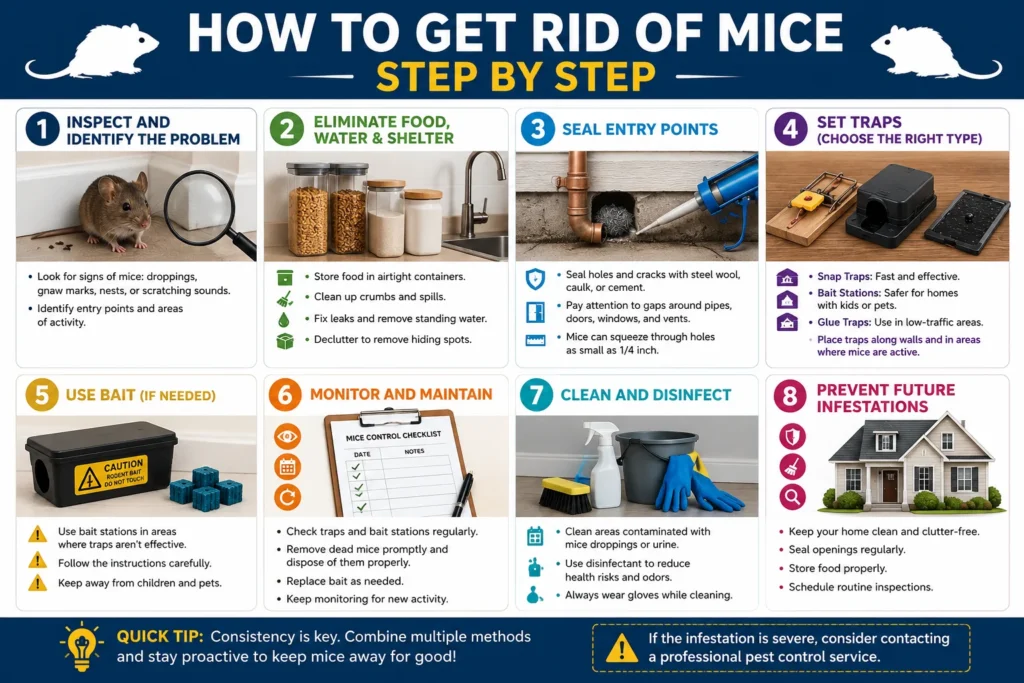
Step 1 — Inspect and Identify Entry Points
Walk around your home’s interior and exterior with a flashlight. Look for any gap larger than a dime. Pay special attention to:
- Where pipes and wires enter the building
- Around the dryer vent
- The bottom edges of garage doors
- Gaps at the roofline
Mark every entry point you find. You’ll seal them in a later step.
Step 2 — Set Mouse Traps Strategically
Traps are the best and quickest way to cut down the mouse population in your home. Put them where mice go: along walls, behind appliances, under sinks, and close to droppings.
Types of mouse traps:
Snap Traps
Snap traps are the most recommended option by pest control professionals. They are fast, affordable, and highly effective. Use peanut butter or soft chocolate as bait. They work better than hard cheese. Mice can smell the fat and sugar in them.
Live Catch Traps
Live traps are a humane option that captures mice without harming them. Once caught, release the mouse at least 10 miles away from your home, or it will find its way back.
Electronic Traps
Electronic traps provide a quick electric shock. They are seen as more humane than glue traps. They cost more upfront but are reusable and very effective.
Glue Traps
Glue traps are widely available but controversial. They can trap non-target animals and are considered inhumane by many. Use them as a last resort or not at all if you have pets or small children.
Pro Tip: Place traps at a 90-degree angle to the wall with the bait side facing the baseboard. Mice run along walls and will walk right into the trap.
Step 3 — Use Bait Stations if Needed
For larger infestations, bait stations (rodenticides) can help. They contain poison that mice eat and carry back to their nests.
Use bait stations with caution:
- Keep them away from children and pets
- Never place them where food is prepared
- Use them outdoors as a perimeter defense when possible
Most pest control experts choose snap traps instead of poison for indoor use. Poisoned mice usually die within walls, which causes a bad smell.
Step 4 — Try Natural Mouse Repellents
Natural repellents are a great choice if you want to avoid chemicals. They can also boost your deterrent efforts.
Best natural ways to get rid of mice:
- Peppermint oil — Mice hate the smell. Soak cotton balls in peppermint oil and place them near entry points, under sinks, and in corners. The menthol compounds irritate their nasal cavities.
- Cayenne pepper — Sprinkle it on baseboards or make sachets for mouse-prone spots.
- Ammonia — The smell mimics predator urine. Place bottle caps filled with ammonia near entry points (out of reach of children and pets).
- Cloves — Wrap whole cloves in cloth and place near hideouts. Mice find the smell unbearable.
- Kitty litter — Place used litter near exterior entry points. The smell of cat urine naturally deters mice.
- Lavender and wormwood are natural deterrents. You can dry them and place them around problem areas.
Note: Natural repellents are best for prevention or used with traps, not as a standalone cure for an active infestation.
Step 5 — Seal All Entry Points
This is the most important long-term step. If you don’t seal entry points, new mice will keep coming in — even after you’ve eliminated the current ones.
Best materials for sealing:
- Steel wool — Mice cannot chew through it. Pack it into gaps around pipes.
- Copper mesh — Another chew-proof option for larger gaps.
- Caulk or expanding foam — Use to seal cracks in walls and foundations.
- Wire mesh — Use to cover vents and larger openings.
Check every gap, even small ones. Mice can flatten their bodies to fit through any opening the size of a dime.
Step 6 — Clean Up and Remove Food Sources
Mice are attracted to easy food sources. Cut off their access and they have little reason to stay.
- Store all dry goods (grains, cereals, pet food) in airtight metal or glass containers
- Clean up crumbs and spills immediately
- Take out the trash regularly and use bins with tight lids
- Fix leaky pipes — mice also seek water, especially during dry periods
- Declutter storage areas like closets, basements, and garages to remove nesting spots
How to Get Rid of Mice in Specific Areas
Mice in Walls
You can’t set traps inside walls, so focus on the areas where mice enter and exit. Place snap traps near holes at the base of walls. Use peppermint oil-soaked cotton balls to drive them out toward the traps. If the problem persists, a professional can use specialized monitoring and baiting tools.
Mice in the Kitchen
The kitchen is the most common target because of food access. Inspect behind appliances like the stove and refrigerator — these are prime hiding spots. Set traps along the back walls of cabinets and under the sink. Remove all accessible food and seal pantry items.
Mice in the Attic
Attics are warm and undisturbed — perfect for nesting. Check for droppings, chewed insulation, and nesting materials. Set multiple snap traps along the attic floor near walls. Seal any gaps in the roofline and around vents.
Mice in the Basement or Garage
These areas offer easy access from outside. Inspect the foundation and around utility lines. Keep garage doors fully closed, especially at night. Use a combination of traps and sealing to clear these spaces.
When to Call a Professional Exterminator
Sometimes the infestation is beyond DIY. Consider calling a professional if:
- You see mice in multiple rooms of your home
- You’re finding droppings every day despite setting traps
- DIY traps haven’t worked after one week
- You find mice in walls or the attic and can’t access the areas yourself
How much does a mice exterminator cost? Professional mouse extermination usually costs between $150 and $550. This price depends on the size of the infestation, your home’s size, and the methods used. A basic inspection alone runs $75 to $125. Long-term prevention plans for larger homes can reach $1,000 or more.
Top-rated companies like Orkin and Terminix provide thorough plans. These plans cover inspection, trapping, sealing entry points, and follow-up visits. For most homeowners, professional extermination is worth it for severe infestations.
You Can Also Read
- How to Get Rid of Drain Flies
- How to Get Rid of Carpenter Ants: Elimination and Prevention
- How to Get Rid of Ants
How to Prevent Mice from Coming Back
Once your home is mouse-free, keeping it that way requires consistent effort. Here’s a simple prevention checklist:
- Inspect your home’s exterior each fall before it gets cold.
- Store all food in sealed containers.
- Don’t leave pet food out overnight.
- Clear clutter from storage areas.
- Trim plants and woodpiles away from your foundation.
- Install door sweeps on all exterior doors.
- Check vent screens for damage regularly.
- Plant peppermint, lavender, or rosemary near entry points.
Regular inspections and basic hygiene habits are the most powerful long-term defense.
Frequently Asked Questions About Getting Rid of Mice
How fast do mice multiply?
Mice can produce up to 10 litters per year, with 6 to 12 babies per litter. A single pair of mice can create a population of 60+ offspring annually. This is why acting quickly is critical.
What smell do mice hate the most?
Mice are strongly repelled by peppermint oil, ammonia, cayenne pepper, and cloves. Ammonia is particularly effective because it mimics the scent of predator urine.
Can mice come back after extermination?
Yes — if entry points aren’t properly sealed. Even after all existing mice are removed, new ones can enter through the same gaps. Always combine extermination with exclusion (sealing) for permanent results.
How long does it take to get rid of mice?
A small infestation can be resolved in 2 to 3 days with well-placed traps. Larger infestations can take weeks or months to handle. This is especially true if you need professional help.
Do ultrasonic repellers work for mice?
Ultrasonic devices can keep mice away at first. However, research shows that mice may get used to the sound over time. Use them as a supplement to traps and sealing — not as the only method.
Is it safe to handle dead mice?
Always wear rubber gloves and a face mask when handling dead mice or cleaning up droppings. Mice carry hantavirus and salmonella. Seal the dead mouse in a plastic bag before disposal and wash your hands thoroughly.
Conclusion: How to Get Rid of Mice for Good
Dealing with a mouse problem doesn’t have to be overwhelming. Act quickly. Use the right mix of traps, natural deterrents, and sealing methods. Stay consistent with prevention.
First, confirm the signs. Then, set snap traps along active paths. Block every entry point with steel wool or caulk. Also, remove all food sources. For natural approaches, peppermint oil and cayenne pepper are your best allies. And if the infestation is out of control, don’t hesitate to call a licensed exterminator.How to get rid of mice is ultimately about taking back control of your home. With this complete guide, you now have everything you need to do exactly that.
About the Author